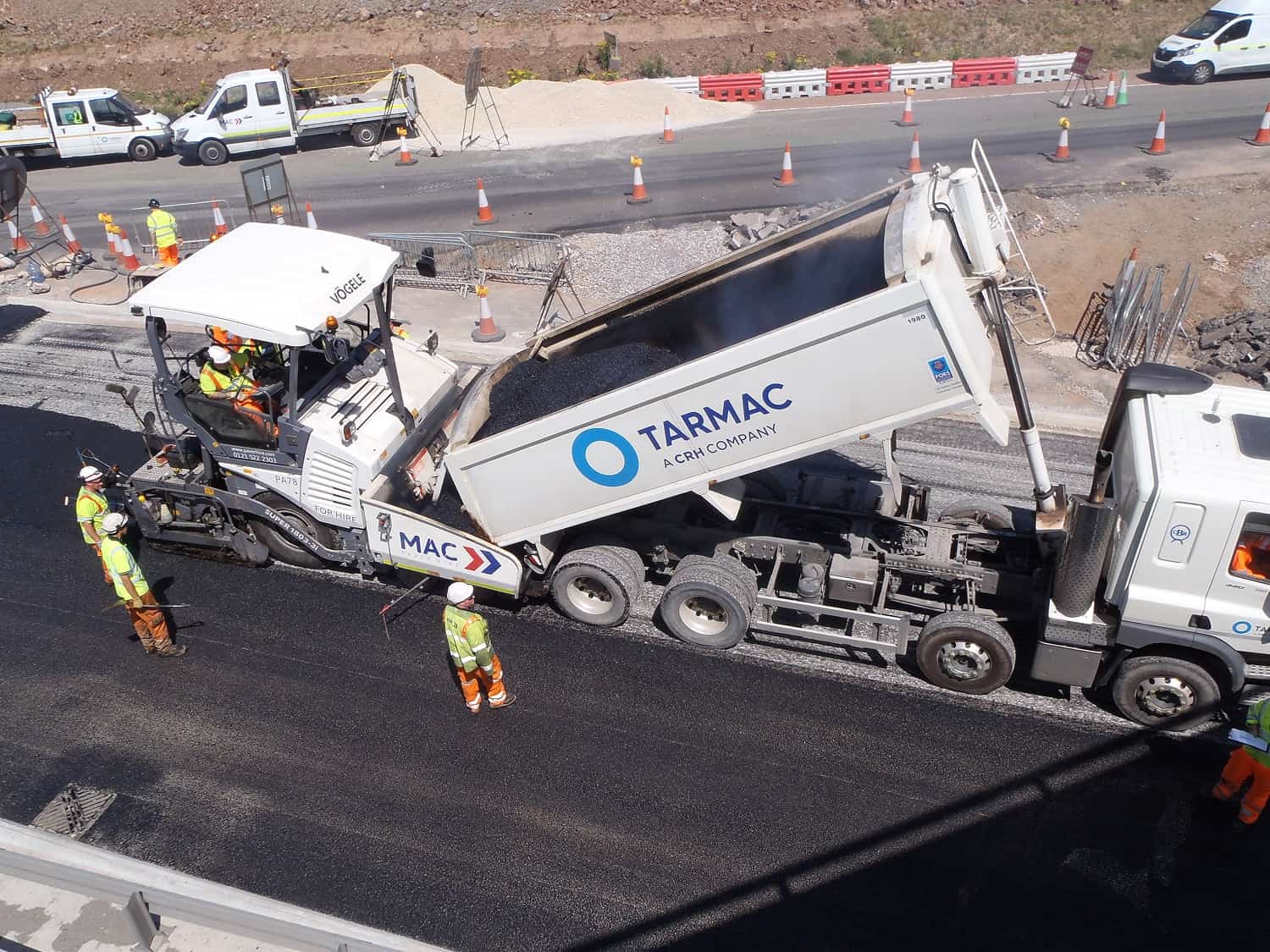

Most surfacing jobs do not go wrong on the day the machines turn up. They go wrong months earlier, at the point someone picks the contractor on price alone and hopes the rest works itself out.
If you are a facilities manager, a landlord, a council buyer or a homeowner reading three quotes that all look roughly the same on paper, this guide gives you the questions that actually separate a contractor who will do the job properly from one who will leave you patching the same failure next winter. Ask these before you sign, not after.
We are a surfacing firm ourselves, so some of the answers below are how we do it. We have flagged those honestly. The checklist stands on its own whoever you use.
1. Do they self-deliver, or do they sub the work out?
This is the first question, because it changes everything after it. A contractor who owns the plant and runs their own crews controls the standard, the diary and the accountability. A contractor who wins the job and then subcontracts it out is one step removed from the work, and when something goes wrong you get finger-pointing between trades instead of a fix.
Ask plainly: are the crews and the plant yours, or are they hired in? Who is actually accountable if the job fails in six months?
How we answer it: our surfacing, planing and the plant behind it are self-delivered. Own crews, own plant, one point of accountability. One contractor, one solution.
2. What accreditations do they hold, and can they show them?
Accreditations are not badges for a website. They are independent proof that a contractor works safely, manages quality and can be audited by someone other than themselves. For a commercial site, a school or a council framework, they are often the difference between a compliant supplier and a liability on your insurance.
Ask which quality, environmental and health-and-safety standards they are certified to, and ask to see current certificates rather than take it on trust.
How we answer it: MAC holds ISO 9001, ISO 14001 and ISO 45001, plus CHAS, CPA, Avetta and Constructionline Gold, and we are an Armed Forces Covenant Silver employer. Full SHEQ compliance, audit-ready.
3. Are the crews trained and carded for the work?
A machine is only as good as the operator in the seat, and a site is only as safe as the people running it. Cheap jobs often come from unnamed agency labour dropped in for the day, which is where quality and safety slip.
Ask what cards and qualifications the operatives and supervisors hold, and whether training is ongoing.
How we answer it: our operatives carry CSCS, MPQC, NPORS and NVQ Level 2. Supervisors and managers hold NVQ up to Level 6, First Aid, SMSTS and SSSTS, with ongoing in-house training. Trained people, not a body in the seat.
4. Will they survey the job, or just quote off a photo?
A contractor who quotes without looking properly is guessing, and a guessed quote is where the surprises come from once the surface is opened up. A reliable contractor wants to understand the drainage, the base and the loading before they price, because those are what make the job last.
Ask whether they will attend site, and whether the quote covers preparation and drainage or only the surface layer.
How we answer it: we look at the whole picture, prep, drainage and materials, because the cheap fix that skips the base is the expensive one when it fails. Built to last starts before the tarmac goes down.
5. Can they do the work without shutting you down?
For a working car park, a school, a care home or a retail site, disruption is a real cost, sometimes bigger than the job itself. Plenty of contractors will close your site because it is easier for them. The better question is whether they will programme the work around you.
Ask whether the works can be phased, done off-peak, done in stages or done in the holidays, with safe access kept open throughout.
How we answer it: it does not have to mean shutdown. Works get programmed around term times, peak hours and off-peak windows, one route at a time where needed, so life keeps moving. Done without disruption.
6. How do they communicate, and who is your point of contact?
The jobs that go smoothly are the ones where you always know what is happening and who to call. The ones that go badly are usually the ones where the contractor went quiet.
Ask who your single point of contact is, how you will get updates, and what happens when something changes on site.
How we answer it: one accountable team means one point of contact, clear scopes and updates, and a straight answer when something changes rather than silence.
7. What happens on the bad day?
Surfacing plant works hard and machines do go down. The measure of a contractor is not that nothing ever goes wrong, it is what they have set up for when it does.
Ask what back-up they hold, and whether a breakdown means your programme stalls or gets recovered.
How we answer it: we run an in-house workshop and 24/7 responsiveness, so if plant goes down we are set up to repair or swap it quickly rather than wait on an external hire desk. We plan for the bad day before it happens.
8. Do they think in whole-life cost, or just the quote?
The cheapest quote is rarely the cheapest job. A car park patched three times in two years costs more in lost trade, complaints and repeat visits than doing it once, properly, would have. A reliable contractor will talk to you about the life of the surface, not just the price on the day.
Ask what they expect the surface to last, and what drives that. If a quote is far cheaper than the others, ask what has been left out to get there.
How we answer it: we do not compete on being the cheapest line on the sheet. Whole-life costing and planning ahead beats reactive patching after every winter. Protect your reputation and budget.
9. Are they straight with you about what they cannot do?
A contractor who says yes to everything is a warning, not a comfort. Honesty about the edge of sensible travel, a tight lead time or a job that needs a different approach is worth more than a confident promise that slips.
Ask them directly what they would not recommend, and listen for whether the answer is honest or just a sale.
How we answer it: if a job sits at the edge of what we can do well we will say so up front, rather than overstretch and let you down mid-programme. A clear answer beats a maybe.
The short version
Choose on self-delivery, real accreditations, trained crews, a proper survey, minimal disruption, clear communication, back-up for the bad day, whole-life thinking and plain honesty. Price belongs on that list, but never at the top of it. The contractor who scores well on the other nine is the one who saves you money over five years.
If you would find it useful to walk your site or your quotes through this checklist with someone who does the work, that is a conversation we are always happy to have.
Frequently asked questions
What is the single most important question to ask a surfacing contractor?
Whether they self-deliver. A contractor who owns the plant and runs their own crews controls the standard and carries the accountability, rather than subcontracting the job and stepping back from it.
What accreditations should a commercial surfacing contractor have?
Look for the quality, environmental and health-and-safety standards (ISO 9001, ISO 14001 and ISO 45001) plus recognised schemes such as CHAS, CPA and Constructionline. Ask to see current certificates rather than take it on trust.
Why is the cheapest surfacing quote often not the cheapest job?
Because the cheap quote usually skips proper preparation, drainage or materials, which is what makes a surface last. A car park patched repeatedly costs more over five years than doing it once, properly. Ask what has been left out to reach a low price.
Can surfacing work be done without closing my site?
Yes, on most sites. A capable contractor programmes the work around your operation, off-peak, in stages or in the holidays, with safe access kept open throughout, so you avoid a full shutdown.
What should I ask about breakdowns and back-up?
Ask what happens when plant goes down mid-job. A contractor with an in-house workshop and rapid responsiveness can repair or swap kit quickly, so a breakdown does not stall your whole programme.