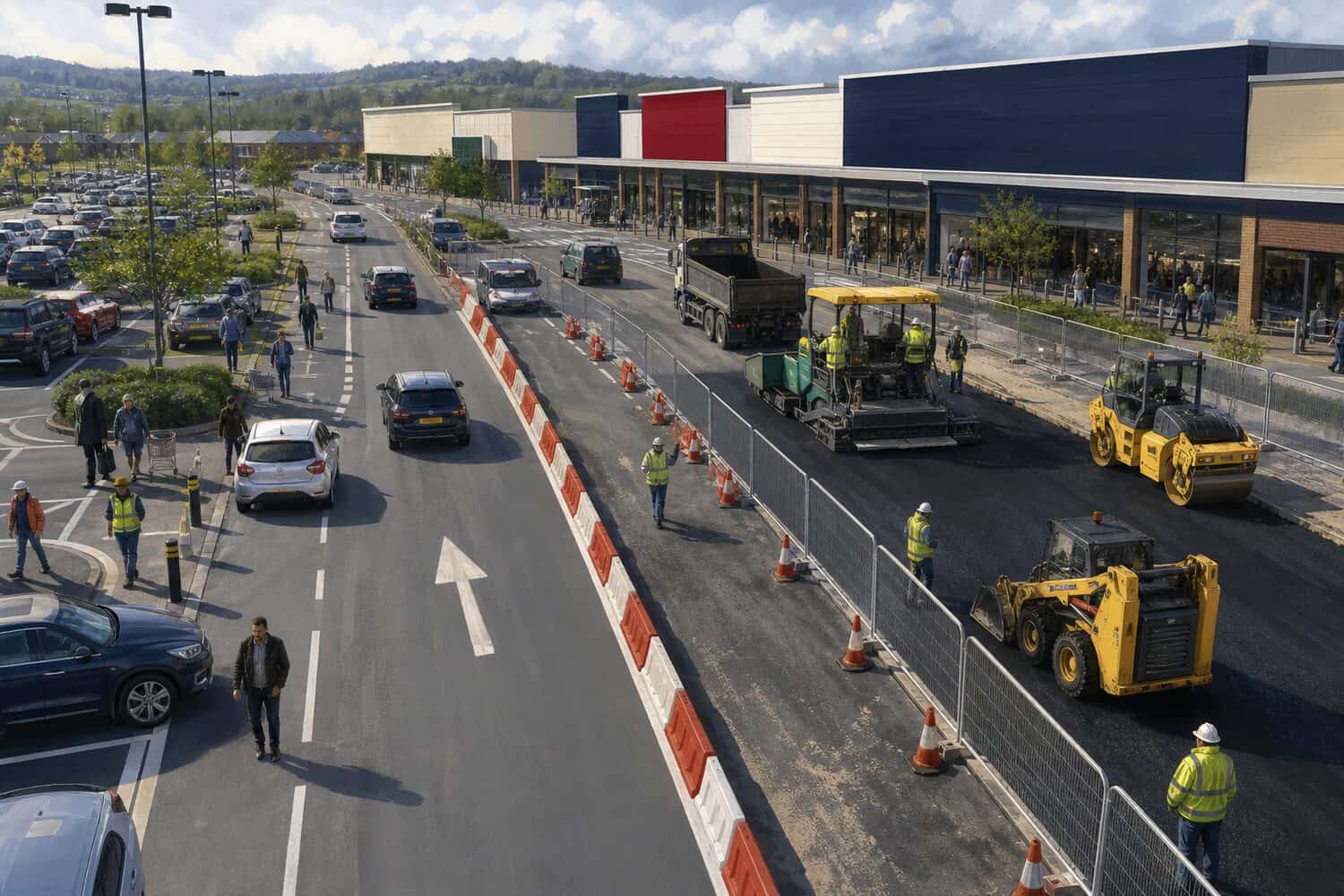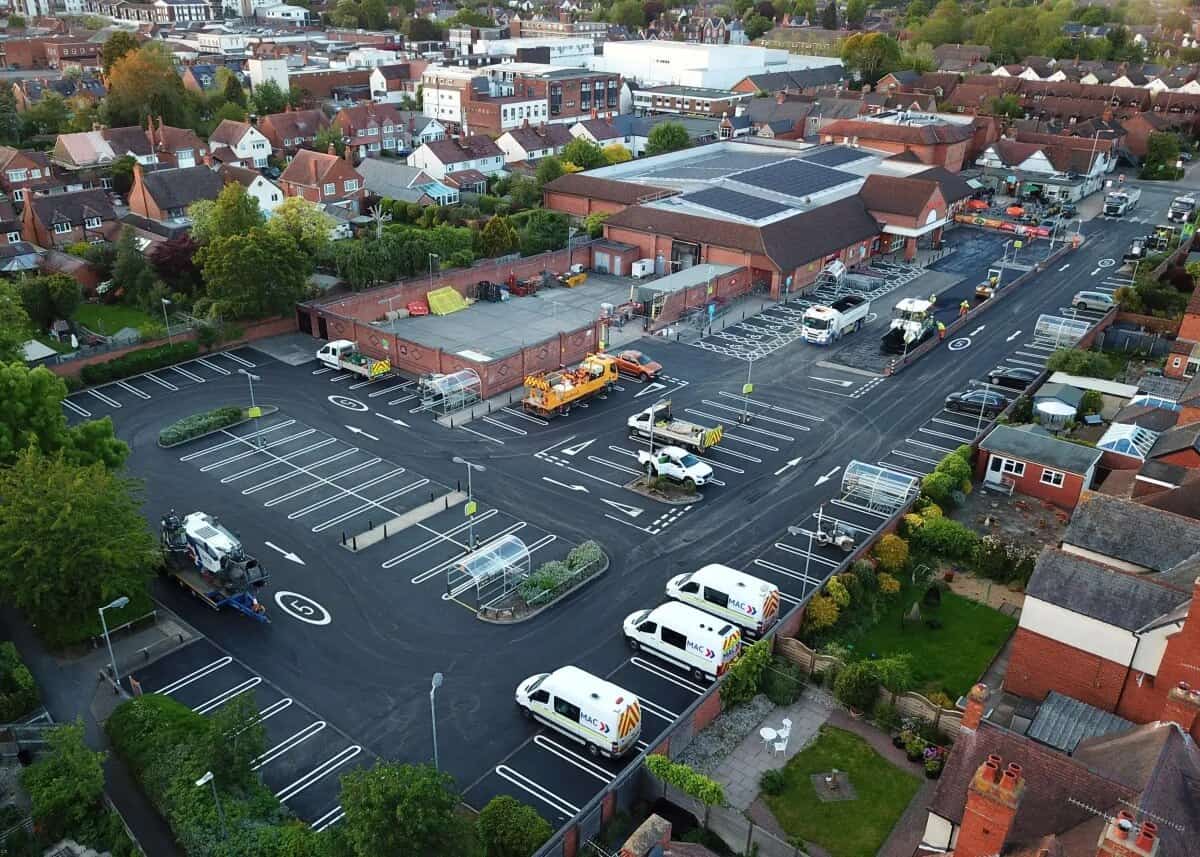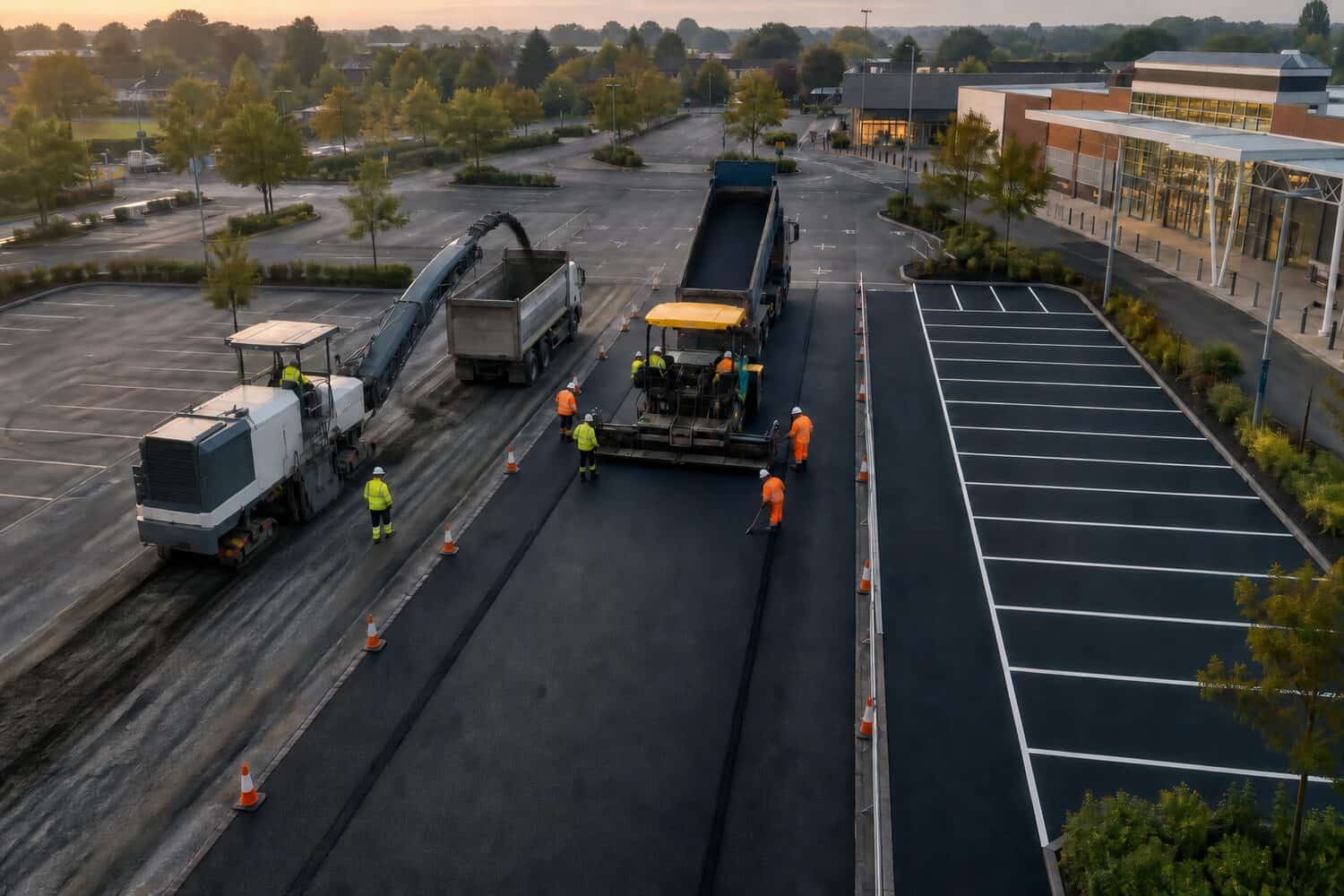
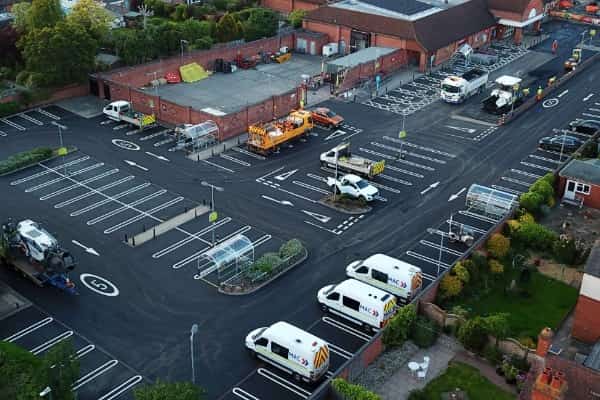

Most commercial sites cannot shut a whole car park for resurfacing and hope the week sorts itself out. Staff still arrive. Customers still need a bay. Deliveries still need a route. That is why phased resurfacing matters: the work is sequenced so the site keeps earning while failed areas are rebuilt properly.
This guide is for facilities managers, landlords, retail operators and estate teams asking whether a car park can be resurfaced in sections. No prices here (always POA after survey). Just how phasing works, when it is realistic, and what has to be planned before the first bay is coned off.
What phased resurfacing actually means
Phasing is not patching with better language. It means splitting the park into workable zones, completing each zone properly, then releasing it back into use while the next zone starts. A typical sequence covers:
- Temporary traffic and pedestrian routes
- Planing and preparation in one zone
- Base repairs and resurfacing in that zone
- Reopening the finished zone before the next one closes
Done well, the site never loses all of its parking at once. Done badly, every zone becomes a dead end and the "open" areas are unusable.
When phasing is the right answer
Phased working is usually strongest when:
- The business must keep trading throughout the programme
- There are enough alternative bays or overflow areas to absorb one closed zone
- Access can be redirected without forcing pedestrians through live plant
- Deliveries, refuse and blue-badge access can be protected in every phase
If the park is tiny, already full every day and has only one entrance, full or near-full closure in a quiet window may still be cleaner. Phasing is a tool, not a virtue.
What has to be true before the first zone closes
A phased programme only works if the logistics are designed first:
- A zone plan that matches how the site is actually used, not a neat drawing on paper
- Temporary signage staff and visitors will understand on day one
- Safe pedestrian routes that do not cross the live resurfacing face
- A place for plant, tippers and materials that does not choke the open parking
- A reopen rule for each finished zone so soft surfaces are not chewed up immediately
If those points are vague, the site will feel shut even while half the bays remain "open". Our guide to how soon you can drive on a new surface sits beside this for a reason: phasing fails when reopen discipline fails.
How good phasing protects trade
The commercial win is continuity. Customers can still park. Staff can still get in. Deliveries still land. The site looks managed rather than abandoned. That matters for:
- Retail and leisure parks that cannot afford a dark forecourt
- Schools and clinics that need accessible routes every day
- Depots and estates where operations cannot pause for a full resurface
Phasing also makes the communication easier. You can tell people which wing is closed this week and which entrance to use, instead of announcing a total shutdown and hoping goodwill holds.
Where phasing creates false comfort
Phasing is the wrong promise when:
- The remaining open area cannot take the displaced traffic
- Plant movements have to cross the only usable customer route
- Drainage or base failure spans so much of the park that tiny zones become inefficient
- The site wants overnight completion of everything and will not protect early reopen zones
In those cases a shorter, better-controlled closure window can cause less pain than a long, messy partial open. Be straight about that before the date is booked.
What to ask a contractor before you accept the programme
Before you approve phased resurfacing, ask:
- Which zones close first, and why that order?
- How many usable bays remain in each phase?
- Where do pedestrians, blue-badge users and deliveries go?
- Where do tippers turn and wait without blocking the open park?
- When does each finished zone reopen, and under what first-use restrictions?
If the answers are generic, the programme is not site-specific enough. A resurface that keeps life moving is a logistics plan as much as a surfacing plan.
Frequently asked questions
Can you resurface a car park in sections and keep it open?
Often yes, if there is enough remaining capacity and the temporary routes are planned properly. Not every layout can support it.
Does phasing make the job take longer?
It can, because the crew is working around live operations. The trade-off is continuity. Many commercial sites prefer a longer phased programme to a short total closure.
Will customers still be able to park?
That depends on the zone plan. A good programme states how many bays remain open in each phase and how people reach them.
Can accessible bays stay open throughout?
Often they can be relocated or protected phase by phase. That needs planning before work starts, not improvising on the day.
Is patching a better way to avoid disruption?
Only if the damage is local and the base is sound. If the same zones keep failing, phased resurfacing is usually the more honest long-term option. See the repair or resurface guide.
Next step
Map the park by use, not just by area. Then ask for a phase plan that protects parking, pedestrians and deliveries while the failed zones are rebuilt.
MAC Surfacing delivers car park resurfacing across the West Midlands and further afield with own crews, own plant and own planing, so phased working can be planned as one accountable programme. On trading sites around the region, the resurfaces that land cleanly are the ones that keep the site usable while the work moves through. Yours can be one of them.