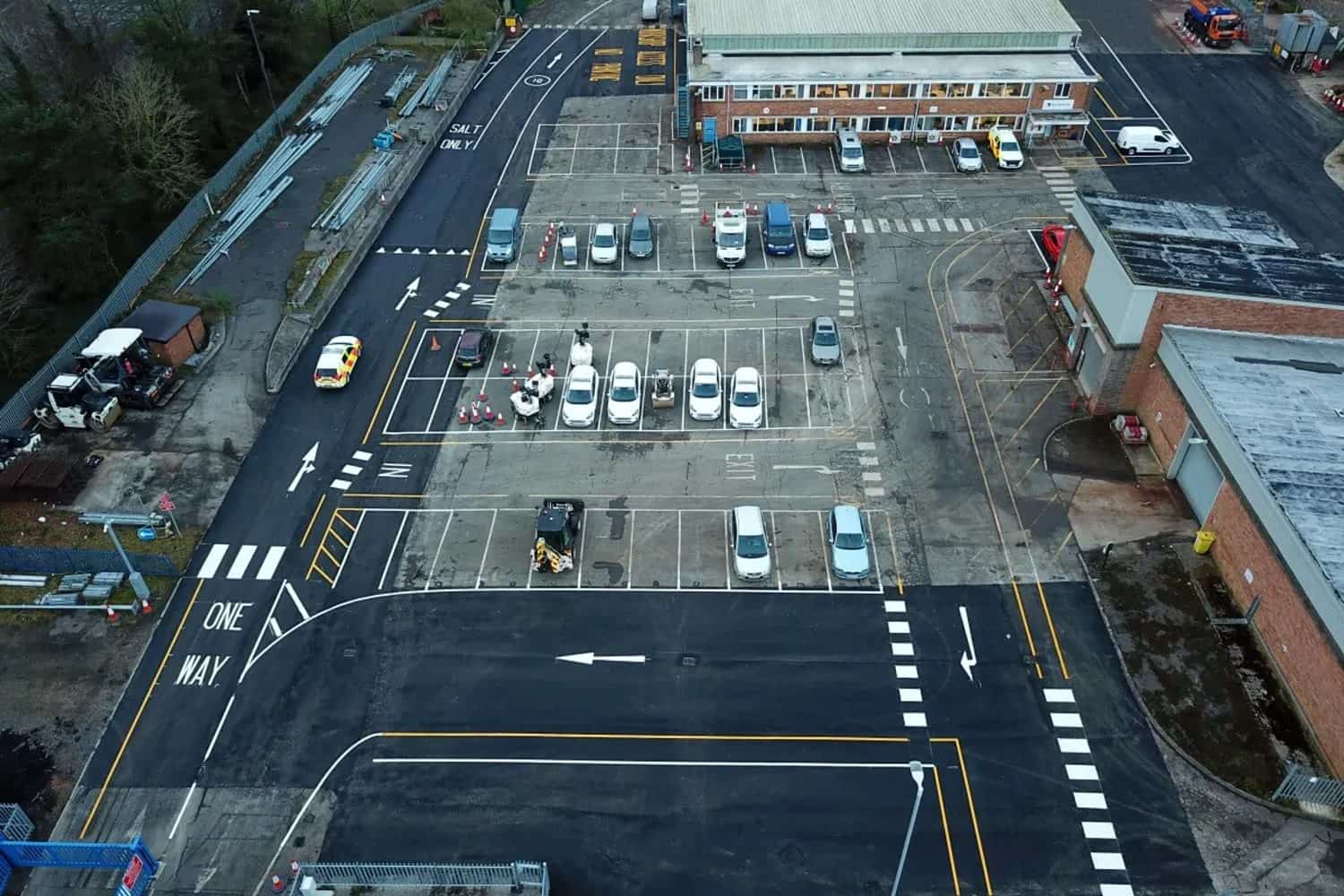

On larger car parks, around 500 m² and over, typical resurfacing at 2026 prices runs from around £16 to £22 per m² for an overlay (an estimate) or from around £21 to £29 per m² to plane off and inlay, ex VAT. Smaller sites cost more per m² and a minimum charge applies. Lining, drainage, kerbs, patching and traffic management are extra. Every site is priced after a survey.
That's the short answer. The rest of this guide explains where those numbers come from, what's in them, what isn't and what moves a price up or down.
It's written for facilities managers, landlords, estate teams and business owners who want to understand a quote before they sign it.
Car park resurfacing prices at a glance
| Job | Larger sites (around 500 m² and over) | Smaller sites (under 500 m²) |
|---|---|---|
| Plane and inlay (typically 40mm) | From around £21 to £29 per m² | Minimum charge applies. Higher per m² |
| Overlay, no planing | From around £16 to £22 per m² (estimate) | Minimum charge applies. Higher per m² |
| Full reconstruction | Priced after survey | Priced after survey |
All prices ex VAT. Indicative only. Not a quote.
Where these numbers come from
They come from our own past car park resurfacing quotes, 2023 to 2026, checked in October 2026.
They're quoted prices, not final invoiced costs. A job can move once the old surface comes off. We'll come back to that.
The overlay range is an estimate. It's built from the surface course rates inside our inlay quotes, not from overlay jobs on their own. Treat it as a guide.
So why publish numbers at all, when every site is different?
We would rather be straight with people about what drives the number than hide it. Most buyers already have a rough idea of the market, so the useful thing we can do is explain the assumptions behind a price.
A range won't price your car park. It will tell you whether a quote in front of you is in the right ballpark and what to ask if it isn't.
What's included in the range and what isn't
Included:
- Planing off the old surface (inlay only)
- Bond or tack coat
- The new surface course, typically 40mm. Thicker layers cost more
Not included, priced separately:
- Line marking
- Traffic management
- Binder patching and regulating
- Kerbs
- Drainage
- Footways
- Ironwork, such as gullies and covers
- Night or weekend working, where it's priced as a separate item
- VAT
If two quotes look far apart, check this list first. One may include half of it and the other none.
Why do small car parks cost more per m²?
Every job carries a fixed cost to get a crew, plant and wagons to site. On a big area that cost is spread thin. On a small one it's a big share of the price.
That's why we don't publish a per m² figure for car parks under about 500 m². It would mislead you. A minimum charge applies instead. We'll tell you what it is once we've seen the site.
Overlay or inlay: which are you paying for?
An overlay lays a new surface over the existing one, where the old surface is sound and the levels allow it. It's usually the cheaper route per m².
It isn't always as cheap as it looks. A real overlay can need regulating to fix the levels, planing at the edges, ramps at entrances, or gullies and covers lifted to the new height. None of that is in the overlay range above.
A plane and inlay takes the worn surface off and lays new material back to the same level. It costs more because of the planing and the waste removal, but it keeps levels at kerbs, doors and drains where they should be.
Full reconstruction means digging out a failed base and rebuilding it before surfacing. There's no sensible range for that without seeing the site.
If you're not sure which you need, read repair or resurface your car park and resurfacing versus reconstruction.
What pushes car park resurfacing cost up?
Tight access. Narrow entrances, low barriers or tight turning can rule out bigger machines and push more work to hand laying. We've priced work from the area alone, then looked at the address and found we couldn't get a machine in. The price had to move.
Keeping the site open. Smaller working zones and crews working around the public take longer. We treat a live site as harder than tight access, because the constraints last the whole job. Night and weekend working can cut disruption, but the uplift lands mostly on labour. See phased car park resurfacing.
A failed base. Soft spots and areas that have moved usually point to the base, not the top layer. Surfacing over it looks fine for a while, then fails again. See surface or base failure.
Planing depth and waste. A deeper cut means more machine time, more wagons and more material to take away.
Drainage and levels. Water kills car park surfaces. Sorting ponding before the new surface goes down is cheaper than after. See car park drainage before resurfacing.
Specification. Cars only is a different job from delivery lorries or refuse wagons. A thicker layer costs more. Porous, coloured or higher slip resistance surfaces change the spec and aren't covered by the ranges above.
Markings and traffic management. Bays, arrows, hatching and signs are easy to leave off a quote. Formal traffic management on a public road is a separate item.
Location. Distance from the depot and the asphalt plant affects haulage and laying temperature.
What brings it down?
- A bigger, continuous area that lets the crew work without stopping and starting
- A site that can close fully, so the crew runs full shifts
- A sound base, so an overlay will do the job
- Combining areas into one visit, so you pay to get plant and people to site once
- Good access for full size machines and wagons
Some of those you control. Some you don't. It's worth knowing which is which before you ask for prices.
Why do quotes for the same car park differ so much?
When quotes are far apart, the contractors are usually pricing different jobs.
In our experience, three things move a car park price more than anything else: access, working hours and what is already underneath. Access decides which machines we can get on site and how much has to be done by hand. Working hours decide whether we can run full shifts or have to work around a site that stays open, at nights or weekends. The existing base decides whether an overlay will do the job or whether parts need full reconstruction. If a quote does not say how it has dealt with all three, treat that as the warning sign.
And the cheap one?
Too often we are compared apples to oranges. When one price is a lot cheaper, it is usually because the spec is not the same or the risk has not been priced in. We run management systems, carry proper insurance and work to safety protocols that protect our workforce and they protect the client too if there is ever an accident on their site.
A cheap price isn't wrong in itself. It's just worth knowing what's missing from it.
How to compare car park quotes like for like
Ask every contractor the same questions:
- Has someone surveyed the site, or is this priced from a drawing or the area alone?
- Overlay, inlay or reconstruction? Why?
- What planing depth and layer thickness are allowed for?
- Is the price ex VAT?
- Which of these are in: markings, traffic management, waste removal, drainage, kerbs, ironwork?
- How will the site stay open? Is night or weekend work priced in?
- What happens if base failure or drainage problems turn up once the old surface is off?
- Are your own crews and plant doing the work, or is it subcontracted?
Line the answers up side by side. Our guide to comparing surfacing quotes goes through it in more detail. How to choose a reliable surfacing contractor covers the wider checks.
When we're not the right fit
We'd rather say this now than after a site visit.
- You need a fixed price from a photo or the area alone. We won't give one. Access, base and drainage change the job and we can't see those from a desk.
- Your car park needs a few repairs, not a resurface. Patching might be the right answer for now. Repair or resurface helps you decide.
- The base has failed across the site. Resurfacing alone won't fix it. You need reconstruction priced properly, by us or someone else.
- You want a domestic driveway done. We don't do domestic driveways. This guide is for commercial and private car parks.
- Your site is a long way outside the West Midlands and small. Our core patch is roughly 60 miles out. We work nationally on larger programmes. If travel would make us poor value for your job, we'll tell you on day one.
Is it worth paying for an inlay over a cheaper fix?
Not always. Sometimes an overlay or a patch is the honest answer.
We see it a lot: a car park patched again and again often ends up costing more than doing it once, properly. You pay for each visit, you put up with the disruption each time and the surface still lets you down. If the base is sound, the right resurface done once usually beats repeat repairs.
See how long a commercial car park surface lasts for the other half of that sum.
Frequently asked questions
How much does car park resurfacing cost per m²?
On larger car parks, around 500 m² and over, at 2026 prices: overlay from around £16 to £22 per m² (an estimate) and plane and inlay from around £21 to £29 per m², ex VAT. Smaller sites cost more per m² and a minimum charge applies.
Do these prices include VAT?
No. All the ranges in this guide are ex VAT.
Does the price include line marking?
No. Lining is priced separately, as are traffic management, drainage, kerbs, patching and ironwork.
Why don't you publish a per m² price for small car parks?
Because the fixed cost of getting a crew, plant and wagons to site makes up so much of a small job. A per m² figure would mislead you. A minimum charge applies instead.
Why is an overlay cheaper than an inlay?
There's no planing and less waste to take away. But an overlay only works on a sound surface with levels that allow it. It can also need regulating, edge planing or ironwork raised, which are extra.
Can you give me a price without visiting?
We can give you the ranges above. A price for your car park comes after a survey, because access, the base and drainage all change the job.
Can the price change once work starts?
It can, if the old surface comes off and the base underneath has failed or a drainage problem turns up. A survey reduces that risk. A good quote says how it has allowed for it.
Next step
Typical car park resurfacing on larger sites runs from around £16 to £22 per m² for an overlay (estimate) or £21 to £29 per m² for plane and inlay, ex VAT, with smaller sites on a minimum charge. Where yours lands depends on access, working hours, the base and what's extra.
We deliver car park resurfacing with our own crews, plant and planers, programmed around how your site trades.
If you'd like a figure for your car park, book a site survey or call 0121 522 2303. If you've already got quotes in, start with how to compare a surfacing quote and see whether they're pricing the same job.
More on our car park resurfacing service. Also see our work for retail and commercial estates and facility and estate teams. One example: car park planing at the Mount Hotel, Tettenhall.